
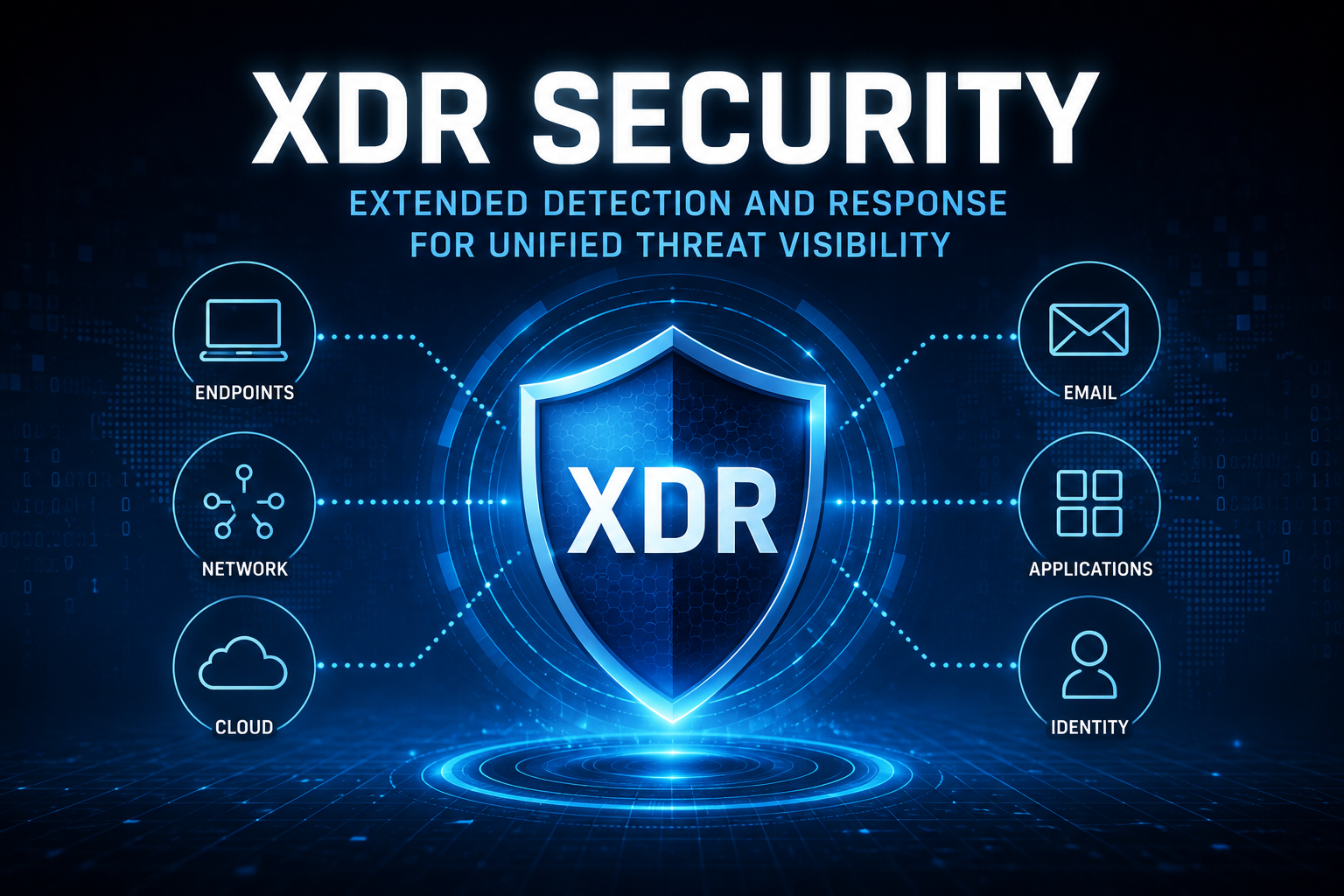
XDR Security: Extended Detection and Response for Unified Threat Visibility
Introduction
Cyber threats are becoming more sophisticated, making it difficult for organizations to detect and respond to attacks using isolated security tools. XDR, or Extended Detection and Response, provides a unified approach by collecting and analyzing security data from multiple environments such as endpoints, networks, cloud platforms, applications, and email systems.
By connecting security signals across different layers of an IT environment, XDR helps security teams identify suspicious activities faster and respond to threats more effectively.
What Is XDR Security?
Extended Detection and Response (XDR) is a cybersecurity approach that integrates threat detection, investigation, and response across multiple security layers.
Unlike traditional security solutions that focus on a single area, XDR brings security telemetry from different sources into a centralized platform. This enables organizations to understand the complete context of an attack instead of investigating individual alerts separately.
How XDR Works
XDR continuously collects security information from different sources, including:
- Endpoint devices
- Network traffic
- Cloud environments
- Email systems
- Applications
- User activities
- Identity systems
The collected data is analyzed to identify relationships between seemingly unrelated security events. When suspicious activity is detected, XDR can generate prioritized alerts and support automated or guided response actions.
Key Benefits of XDR
1. Unified Threat Visibility
XDR provides security teams with a broader view of activities across the organization. This makes it easier to identify attack patterns that may remain hidden when security tools operate separately.
2. Faster Threat Detection
By correlating security events from multiple sources, XDR can help identify suspicious behavior earlier and reduce the time required to investigate incidents.
3. Improved Incident Investigation
Security analysts can examine related events within a single security environment rather than manually collecting information from multiple tools.
4. Automated Response
XDR platforms can support automated response actions such as isolating compromised endpoints, blocking malicious activity, or restricting suspicious accounts.
5. Reduced Alert Fatigue
Security teams often receive large numbers of alerts from different security products. XDR can correlate related alerts and help prioritize the incidents that require immediate attention.
XDR vs Traditional Security Tools
Traditional security solutions often monitor individual security layers. For example, endpoint security focuses on devices, while network security monitors network activity.
XDR connects these security layers and provides a more complete view of potential attacks. This integrated approach can improve visibility, investigation, and response across the organization's digital environment.
XDR and SOC Operations
XDR can complement Security Operations Center (SOC) activities by providing centralized security telemetry, threat correlation, investigation capabilities, and response workflows.
For organizations operating 24/7 security monitoring, XDR can help analysts investigate incidents more efficiently and identify threats across multiple environments.
Why Businesses Need XDR
Modern organizations use cloud applications, remote work environments, connected devices, and multiple business applications. This creates a larger attack surface for cybercriminals.
XDR helps organizations address this complexity by connecting security information from different environments and providing security teams with a unified perspective of potential threats.
Conclusion
XDR Security provides a unified approach to modern threat detection and response. By combining security intelligence from endpoints, networks, cloud environments, applications, and other sources, organizations can improve visibility and strengthen their incident response capabilities.
For businesses dealing with increasingly complex cyber threats, XDR can become an important component of a modern cybersecurity strategy.
 UK
UK
 USA
USA
 UAE
UAE
 Canada
 Australia
 Germany
 Singapore
 Netherlands