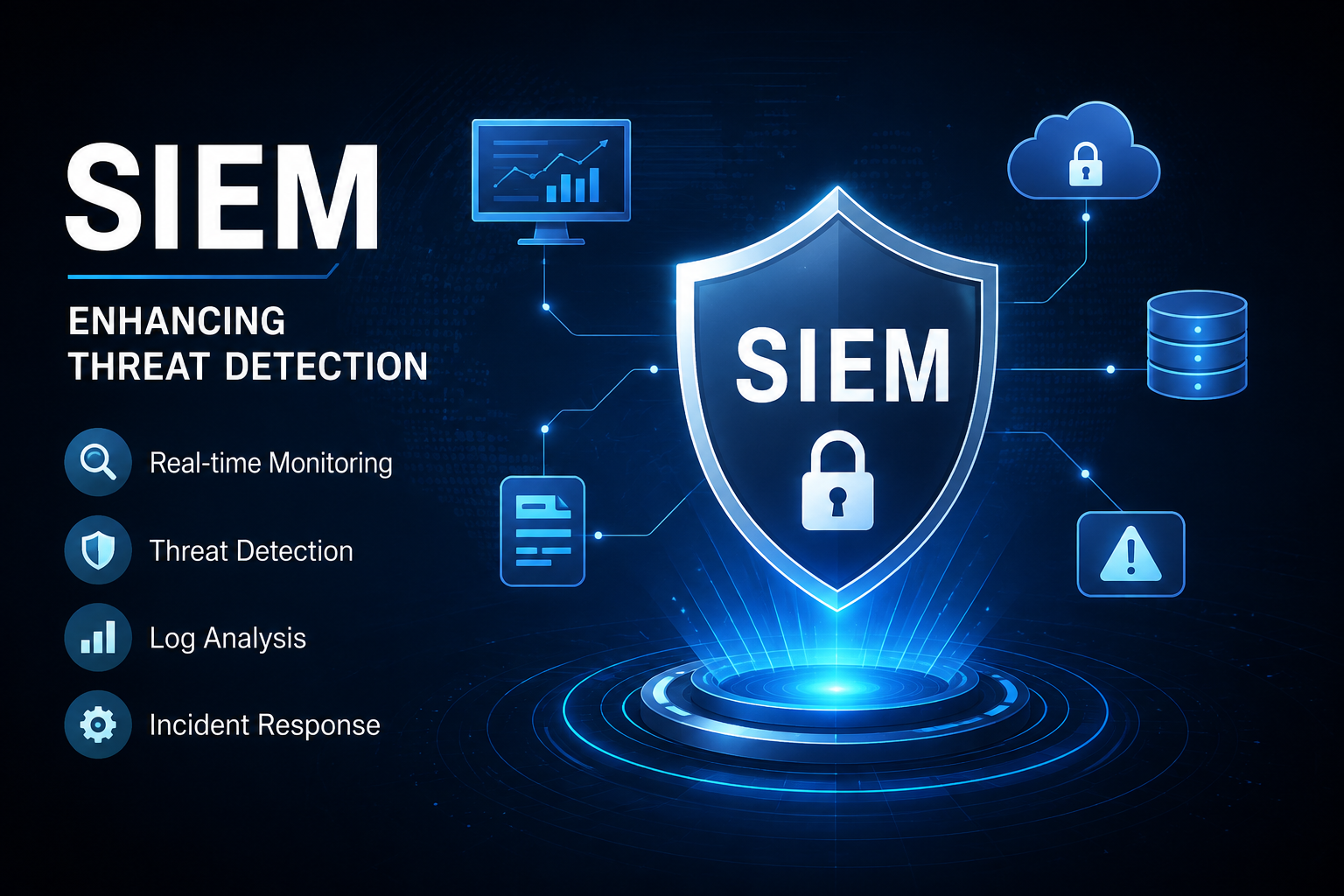
Security Information and Event Management (SIEM): Enhancing Threat Detection
Introduction
Cyber threats are becoming more sophisticated, making it difficult for businesses to identify suspicious activities using traditional security tools alone. Security Information and Event Management (SIEM) helps organizations collect, analyze, and monitor security data from multiple sources in real time.
SIEM provides security teams with centralized visibility into their IT environment, helping them detect potential threats and respond to security incidents more effectively.
What Is SIEM?
Security Information and Event Management (SIEM) is a cybersecurity solution that collects security logs and event data from different systems, applications, servers, networks, and endpoints.
It analyzes this information to identify unusual patterns, suspicious behavior, and potential security incidents. By bringing security information into one centralized platform, SIEM makes threat monitoring and investigation more efficient.
How Does SIEM Work?
A SIEM platform generally works through several key processes:
- Data Collection: Collects logs and security events from servers, firewalls, applications, endpoints, and other systems.
- Log Aggregation: Brings security data into a centralized location for easier monitoring.
- Event Correlation: Connects related events to identify suspicious patterns.
- Threat Detection: Uses rules, analytics, and threat intelligence to detect potential attacks.
- Alert Generation: Notifies security teams when suspicious activity is identified.
- Incident Investigation: Helps analysts investigate events and understand the scope of an incident.
Benefits of SIEM for Businesses
1. Centralized Security Visibility
SIEM provides a unified view of security events across the organization's IT environment, making it easier to monitor potential threats.
2. Faster Threat Detection
By analyzing security events in real time, SIEM can help security teams identify suspicious activities before they develop into major incidents.
3. Improved Incident Response
Security teams can use SIEM data to investigate incidents, understand attack patterns, and take appropriate action quickly.
4. Better Compliance Management
SIEM can help organizations maintain security logs and generate reports that support various regulatory and compliance requirements.
5. Threat Intelligence Integration
Many SIEM solutions can integrate threat intelligence feeds to improve the identification of malicious IP addresses, domains, malware indicators, and other threats.
Common Threats Detected by SIEM
SIEM solutions can help detect various security threats, including:
- Unauthorized login attempts
- Credential attacks
- Malware activity
- Insider threats
- Suspicious network behavior
- Data exfiltration
- Privilege escalation
- Brute-force attacks
- Account compromise
- Unusual user activity
SIEM and Modern Cybersecurity
Modern organizations generate huge amounts of security data every day. Manually reviewing these logs is time-consuming and can cause important security events to be overlooked.
SIEM helps security teams prioritize important alerts and investigate suspicious activity using centralized security information. When combined with technologies such as EDR, threat intelligence, vulnerability management, and automated response, SIEM can become an important component of a modern security operations strategy.
Challenges of SIEM
Although SIEM provides significant security benefits, organizations may face challenges such as:
- Large volumes of security data
- False-positive alerts
- Complex configuration
- Integration challenges
- High storage and operational requirements
- Need for skilled security professionals
Proper configuration, continuous monitoring, and regular tuning can help organizations overcome these challenges.
Best Practices for Implementing SIEM
Organizations should consider the following practices when deploying SIEM:
- Identify the most important systems and data sources.
- Configure relevant log collection and monitoring.
- Create effective detection rules and alerts.
- Integrate reliable threat intelligence sources.
- Regularly review and tune alerts to reduce false positives.
- Establish clear incident response procedures.
- Continuously monitor and improve SIEM performance.
Conclusion
Security Information and Event Management (SIEM) provides organizations with centralized security visibility, faster threat detection, and valuable insights for incident investigation. As cyber threats continue to evolve, SIEM can help businesses strengthen their security operations and respond to suspicious activity more efficiently.
For organizations looking to improve their cybersecurity monitoring and threat detection capabilities, implementing a properly configured SIEM solution can be an important step toward building a stronger and more proactive security strategy.
 UK
UK
 USA
USA
 UAE
UAE
 Canada
 Australia
 Germany
 Singapore
 Netherlands