
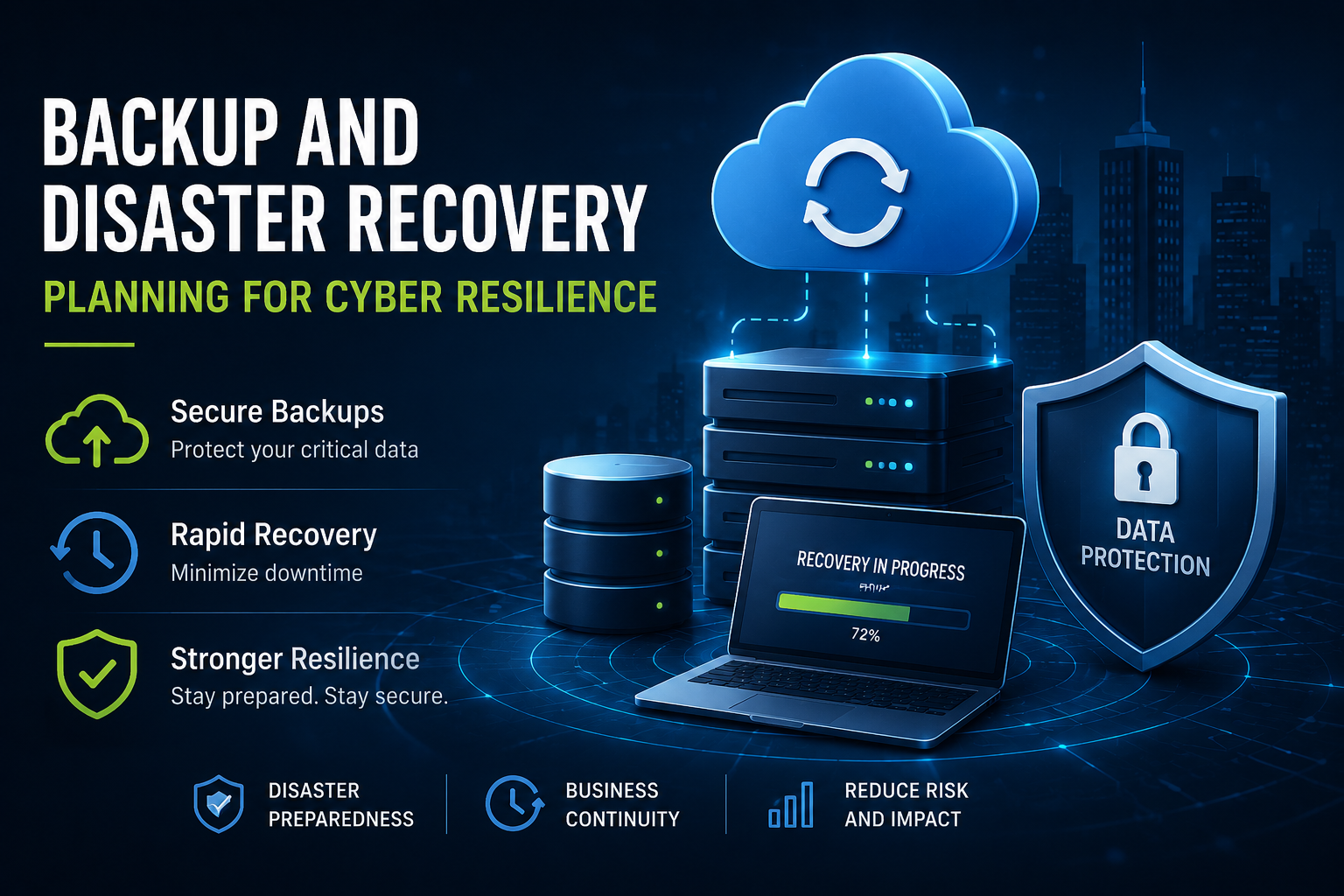
Backup and Disaster Recovery: Planning for Cyber Resilience
In today’s digital environment, cyberattacks, system failures, hardware damage, and unexpected incidents can seriously disrupt business operations. Backup and Disaster Recovery (BDR) plays an important role in helping organizations protect critical data and restore essential services after a disruption.
What Is Backup and Disaster Recovery?
Backup is the process of creating copies of important data and storing them securely so they can be restored when needed. Disaster Recovery (DR) is the broader process of restoring systems, applications, data, and business operations after an incident.
Together, backup and disaster recovery help organizations minimize downtime and maintain business continuity.
Why Is Disaster Recovery Planning Important?
A successful cyberattack can result in data loss, system downtime, financial damage, and reputational harm. A well-designed disaster recovery plan helps organizations respond quickly and recover critical operations.
Key benefits include:
- Protecting critical business data
- Reducing operational downtime
- Supporting business continuity
- Improving incident response
- Minimizing financial losses
- Strengthening overall cyber resilience
Common Threats That Require Disaster Recovery
Organizations should prepare for different types of disruptions, including:
- Ransomware and malware attacks
- Data breaches
- Hardware or software failures
- Accidental data deletion
- Cloud service outages
- Natural disasters
- Power failures
- Insider-related incidents
Having reliable backups and a tested recovery strategy can significantly reduce the impact of these events.
Key Elements of a Disaster Recovery Plan
1. Identify Critical Systems and Data
Organizations should determine which applications, systems, and data are essential for business operations. This helps prioritize recovery efforts during an emergency.
2. Follow the 3-2-1 Backup Strategy
The 3-2-1 approach recommends maintaining three copies of data, stored on two different types of media, with one copy kept offsite. Organizations can also consider immutable or offline backups for stronger protection against ransomware.
3. Define Recovery Objectives
Two important metrics are Recovery Time Objective (RTO) and Recovery Point Objective (RPO).
- RTO: The maximum acceptable time required to restore a service.
- RPO: The maximum acceptable amount of data that can be lost, measured in time.
4. Secure Backup Data
Backups should be protected using encryption, access controls, strong authentication, and appropriate network segmentation. Backup credentials should also be protected from unauthorized users.
5. Test the Recovery Plan
A disaster recovery plan should not simply exist as a document. Organizations should regularly test backups and recovery procedures to identify weaknesses and ensure systems can actually be restored.
How BDR Supports Cyber Resilience
Cyber resilience is the ability of an organization to prepare for, withstand, respond to, and recover from cyber incidents. Backup and disaster recovery are essential components of this strategy because they provide a path to restore operations after an attack.
For example, if ransomware encrypts production systems, secure and isolated backups can help an organization recover critical data without relying solely on the compromised environment.
Best Practices for Disaster Recovery
Organizations should:
- Regularly back up critical data.
- Keep at least one backup isolated from the production environment.
- Use encryption and strong access controls.
- Monitor backup activities for suspicious behavior.
- Define clear roles and responsibilities.
- Document recovery procedures.
- Test recovery processes regularly.
- Update the disaster recovery plan as systems and business requirements change.
Conclusion
Backup and Disaster Recovery is more than a data protection strategy—it is a key part of modern cyber resilience. By maintaining secure backups, defining recovery objectives, and regularly testing recovery procedures, organizations can reduce downtime and recover more effectively from cyber incidents and other unexpected disruptions.
A proactive disaster recovery strategy helps businesses stay prepared, protect critical information, and continue essential operations even when unexpected threats occur.
 UK
UK
 USA
USA
 UAE
UAE
 Canada
 Australia
 Germany
 Singapore
 Netherlands