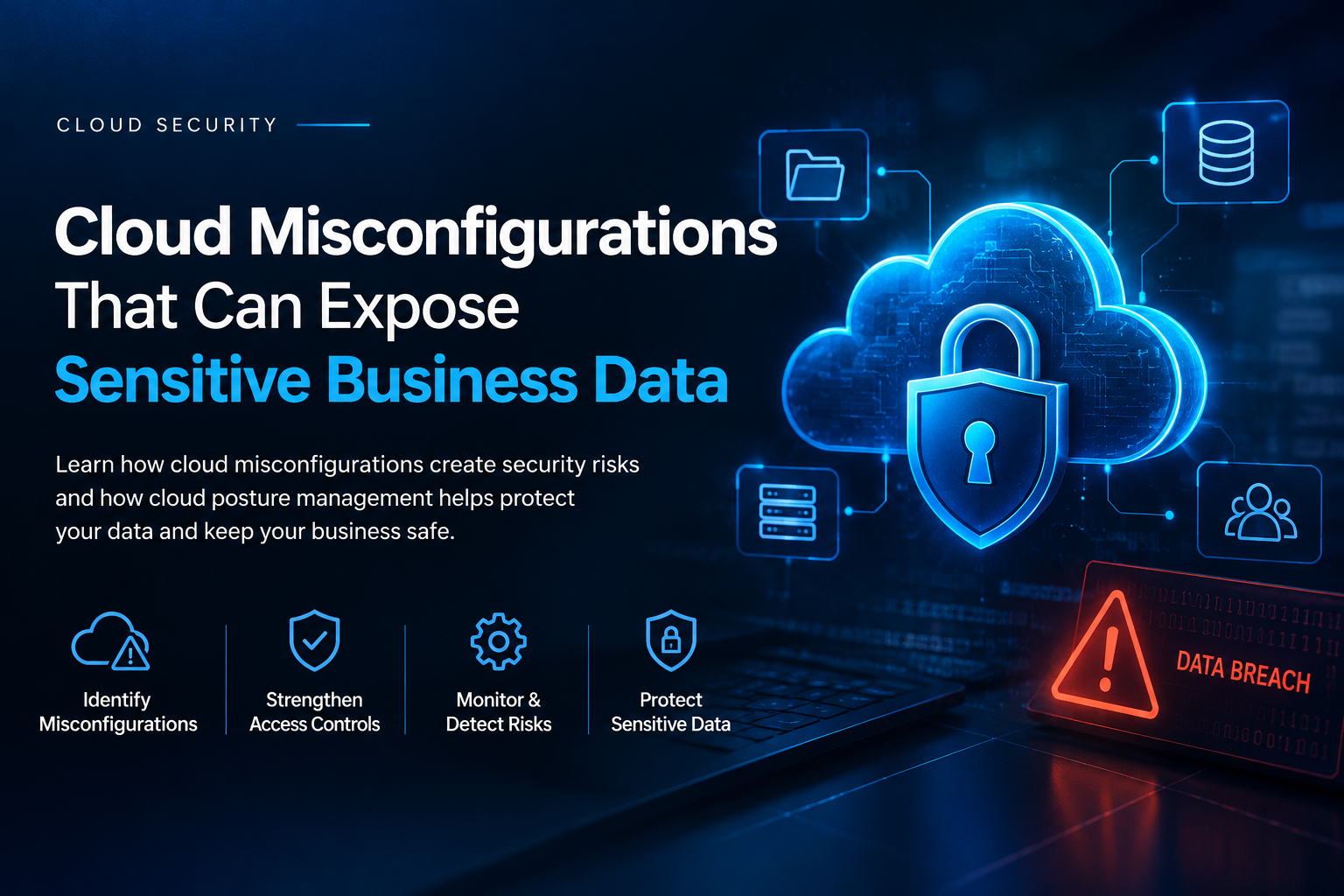
Cloud Misconfigurations That Can Expose Sensitive Business Data
Introduction
Cloud technology helps businesses store data, manage applications, and access important information from anywhere. However, incorrect cloud settings can create security risks and expose sensitive business data. Many organizations use cloud platforms for daily operations, but even a small configuration mistake can leave important files, databases, and applications open to unauthorized access.
Cloud misconfigurations are a common security concern because businesses often manage multiple cloud services, users, and applications. Understanding these risks and taking the right precautions can help organizations protect their information and maintain a secure cloud environment.
What Are Cloud Misconfigurations?
Cloud misconfigurations occur when cloud services, storage systems, access permissions, or security settings are not configured correctly. These mistakes may happen during initial setup, system updates, or routine cloud management.
For example, a company might accidentally allow public access to a storage folder containing customer records. Similarly, weak access controls or disabled security monitoring can make it easier for attackers to access confidential information.
Businesses can reduce these risks by regularly reviewing their cloud settings and following proper security practices.
Common Cloud Misconfigurations That Put Business Data at Risk
1. Publicly Accessible Cloud Storage
Cloud storage services are often used to keep business documents, customer information, and backup files. If storage permissions are configured incorrectly, these files may become accessible to people outside the organization.
Businesses should review storage permissions, disable unnecessary public access, and ensure that sensitive information is available only to authorized users.
2. Weak Identity and Access Management
Incorrect user permissions can allow employees or external users to access information they do not need. Shared accounts, excessive privileges, and weak authentication can increase the chances of unauthorized access.
Organizations should follow the principle of least privilege, use multi-factor authentication, and review user permissions regularly.
3. Unprotected Databases and Applications
Cloud databases and applications may expose sensitive information when authentication, network restrictions, or encryption settings are not properly configured. Attackers can take advantage of these weaknesses to access business records or disrupt operations.
Businesses should secure database connections, restrict access to trusted networks, and apply appropriate encryption controls.
4. Misconfigured Network Security Rules
Cloud environments use firewalls, security groups, and network access rules to control incoming and outgoing traffic. Incorrect rules may expose administrative interfaces, databases, or internal services to the public internet.
Security teams should remove unnecessary open ports, restrict access to trusted IP addresses where appropriate, and test network rules regularly.
5. Missing Security Monitoring and Alerts
Without proper monitoring, businesses may not notice unusual login attempts, suspicious data transfers, or unexpected changes to cloud configurations.
Cloud logging, automated alerts, and continuous monitoring help security teams identify potential threats and respond before an incident causes significant damage.
How Cloud Posture Management Helps Prevent Misconfigurations
Cloud Posture Management helps organizations assess their cloud environments, identify security weaknesses, and maintain appropriate security configurations. It provides visibility into cloud resources and helps teams understand which settings require attention.
An effective cloud posture management process includes:
- Configuration assessments: Check cloud resources for incorrect or risky settings.
- Risk prioritization: Identify issues based on their potential impact and exposure.
- Access reviews: Ensure users and applications have only the permissions they require.
- Continuous monitoring: Detect configuration changes and emerging security risks.
- Compliance checks: Compare cloud configurations against relevant security policies and standards.
- Remediation: Correct identified issues and verify that the changes have reduced the risk.
These practices help businesses maintain better control over their cloud infrastructure and reduce the likelihood of accidental data exposure.
Best Practices for Protecting Sensitive Cloud Data
Organizations can improve cloud security by following a few essential practices.
First, establish clear security policies for cloud storage, applications, databases, and user accounts. Regularly review these settings to identify unintended access or outdated permissions.
Second, enable multi-factor authentication and apply least-privilege access controls. This limits the damage that can occur if an account is compromised.
Third, protect sensitive information with encryption both at rest and in transit. Securely manage encryption keys and avoid storing credentials or access keys in publicly accessible locations.
Businesses should also use automated configuration checks, maintain reliable backups, update cloud resources regularly, and create an incident response plan. Regular security assessments can help identify weaknesses before they are exploited.
For additional protection, organizations can explore Rashicore's cloud security services: https://www.rashicore.com/cloud-security.php
Why Regular Cloud Security Assessments Matter
Cloud environments change frequently as businesses introduce new applications, create user accounts, and expand their infrastructure. A configuration that was secure initially may become risky after a later update or operational change.
Regular assessments help organizations identify exposed resources, unnecessary permissions, and security gaps. They also support better risk management by helping teams prioritize the issues that could have the greatest impact on business operations.
A consistent assessment schedule, combined with continuous monitoring, makes it easier to maintain a secure cloud environment as business requirements evolve.
Conclusion
Cloud misconfigurations can expose sensitive business data, weaken access controls, and create opportunities for cyberattacks. Businesses can reduce these risks by reviewing configurations regularly, enforcing strong identity controls, protecting data with encryption, and monitoring cloud activity continuously.
Cloud Posture Management plays an important role in identifying weaknesses and helping organizations maintain secure cloud environments. By combining regular assessments with continuous monitoring and timely remediation, businesses can protect valuable information and improve their overall security posture.
To strengthen your cloud environment and reduce configuration-related risks, visit https://www.rashicore.com/cloud-security.php .
 UK
 USA
 UAE
 Canada
 Australia
 Germany
 Singapore
 Netherlands